 KOHAKU WORKS
I Made a YouTube Video with AI ── Behind the Scenes of Kojiki Episode 1
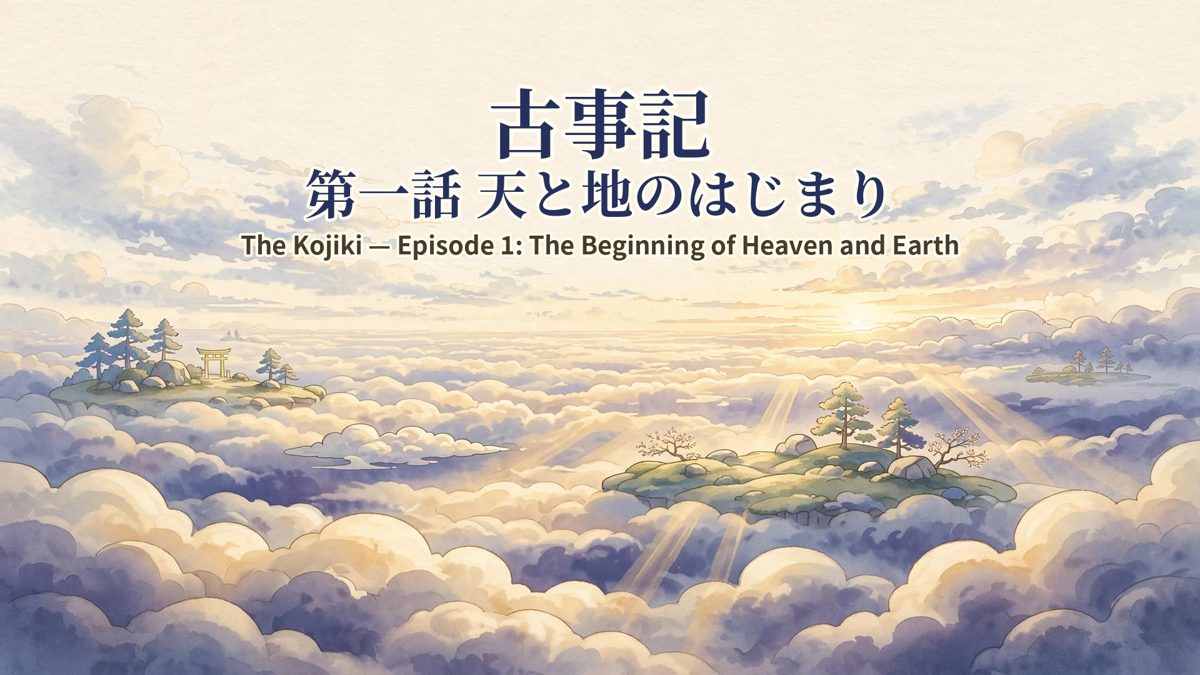
This is a long page. If you only follow the highlighted parts, you will still get the main points.
Introduction
This page is not an introduction to the finished work. It is a behind-the-scenes journal of actually making a YouTube video with AI. The subject is Episode 1 of the Kojiki series, "The Beginning of Heaven and Earth." I recorded the whole path from planning to completion — including what went well, what failed, and what AI could not be trusted with.
It started with making Shorts videos of Japanese folktales. From there, the project moved on to a series based on the Kojiki, Japan's oldest chronicle. The series is planned as 20 episodes, in both Japanese and English. For the art style, I chose a "bright anime picture-book style" from the candidates. The videos are not forced into one minute; each one uses as much time as the story needs.
The workflow: planning is done in writing only, and every script is also checked by a second AI. Then the materials — art and audio — are produced, the video is assembled and inspected, and in the end a human decides whether to accept it. Production is led by Muse, Meta's AI assistant. What I learned from finishing Episode 1 is that the steps AI can handle and the steps that only move forward with human judgment split apart very clearly.
The setup
Everything is made on a single home computer. No special equipment, and no production-company setup. It is an experiment: how far can one person and AI go in making videos worth posting on YouTube?
| Computer | One home desktop PC |
|---|---|
| Graphics card | GeForce GTX 1660 Ti (6 GB of video memory) |
| Memory | 16 GB |
| Image generation | ComfyUI (running on my own PC) |
| Roles | Planning, inspection and final decisions are human; making materials, assembly and checking work are shared with AI |
| Production lead | Muse (Meta's AI assistant) |
With this setup, Episode 1 was completed as four videos: the main video and a Short, each in Japanese and English. Here is how it went, step by step.
Writing the script with AI
For the script, I adopted a plain-language retelling — the "gentle version" — as the production script. How closely it follows the original text is also checked by a second AI, and fixed based on that.
When the first draft went through review, the comments covered a lot of ground: the story has no payoff; the two gods' proportions differ too much; the male god's colors blend into the background; the first half is only scenery and feels dull, so show figures and processions of the gods; and the spear should be lowered not into "water" but into "the sea."
Acting on those comments, I rebuilt the ending. Episode 1 would now run all the way to "the birth of the island," with a new scene added. With that change, the episode break moved as well: Episode 2 now begins with the two gods descending to the island.
The details were fixed too. The three gods are introduced one at a time, and the pair is introduced not as "brother and sister" but as "a pair of gods, a god and a goddess." Meaningful-looking explanations of numbers were cut, and the spear was given its name, Amenonuboko.
Checking against the original text brought a surprise. The word "land" used in the final scene never appears in the original text at all — it was a word invented on the production side. The original only uses three words here: "country," "salt" and "island." So "land" was removed and corrected. The reading of Amenonuboko was also wrong in my first assumption; I checked the sources and standardized it.
The script was finalized in its second version. Information from the original that is left out of the narration is provided in subtitles and in the video description.
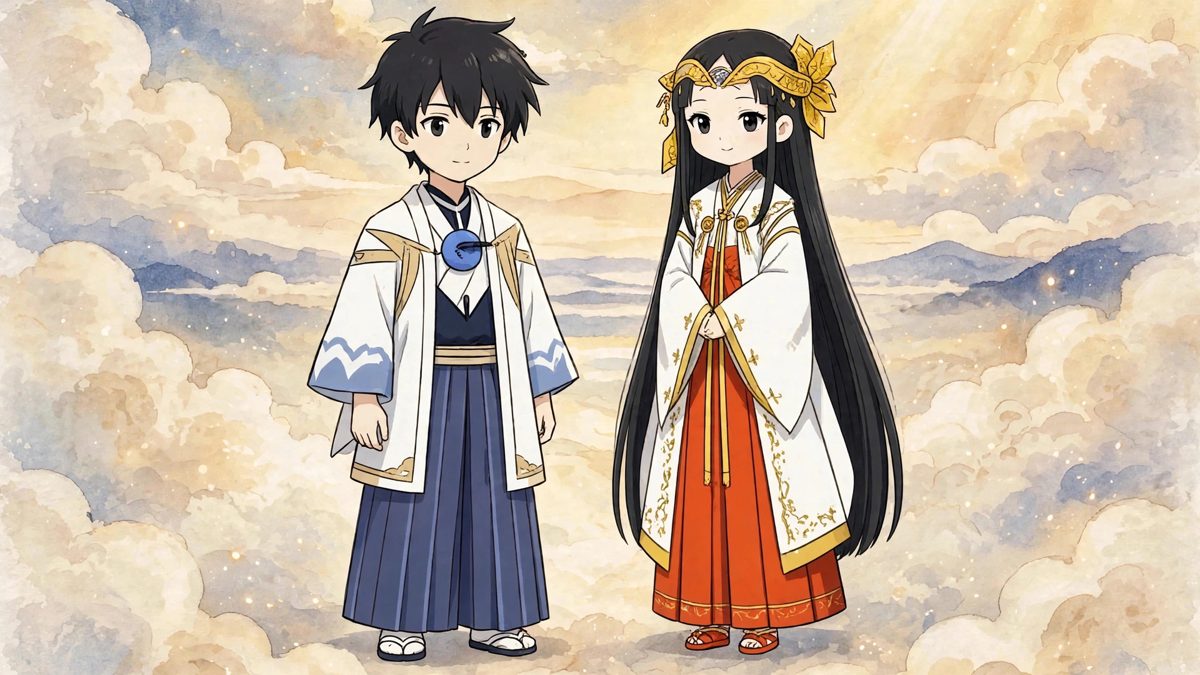
First draft vs. final script
Here are three passages where the change is easy to see, taken from the first draft of the gentle version and the final second version (English narration scripts). They show how much rewriting actually went in.
1. Introducing the two gods
First draft
"The last ones born were a brother and sister — Izanagi and Izanami."
Final
"The last ones born were a pair of gods — Izanagi, a god, and Izanami, a goddess."
2. Receiving the spear
First draft
"The gods of heaven gave the two a beautiful jeweled spear. 'Use it,' they said, 'to shape the drifting land below, and make it strong.'"
Final
"The gods of heaven gave the two a spear called Amenonuboko — the Spear of Heaven. And they said: 'With this spear, make firm the land that floats and drifts upon the sea.'"
3. The ending
First draft ending
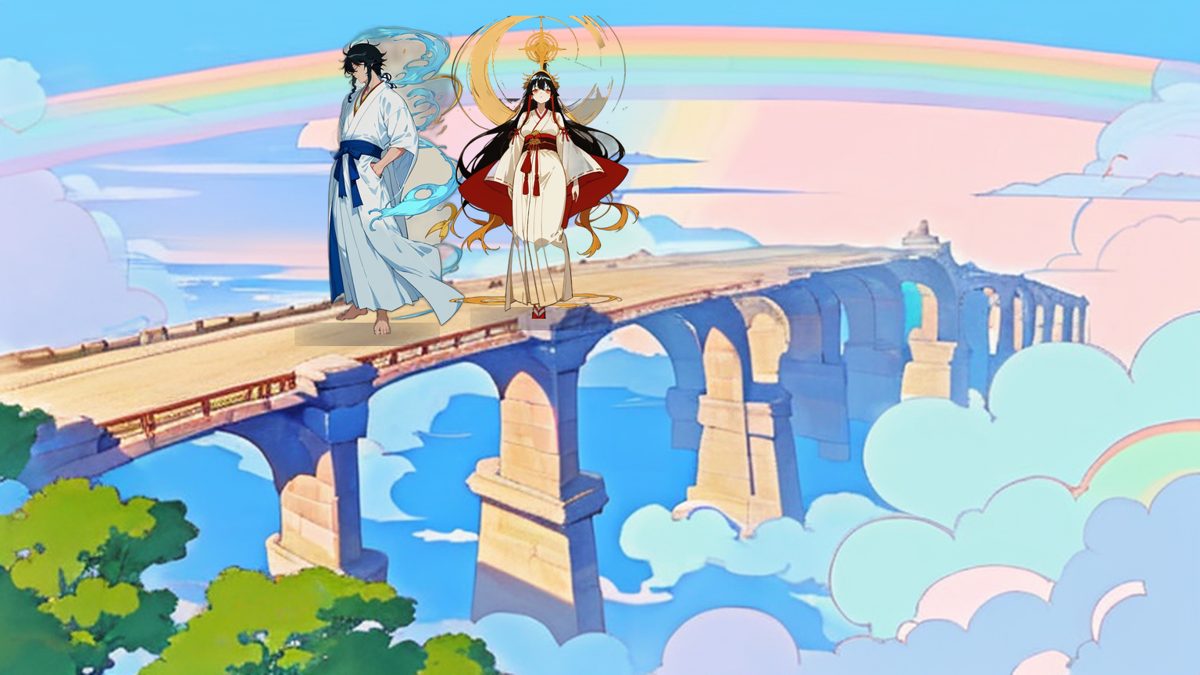
"The two stood on a bridge floating high in the sky. Far below was the sea, and on it, a young land drifting. Slowly, they lowered the spear toward the water."
The first draft ended here, with the rest left for the next episode.
Final ending
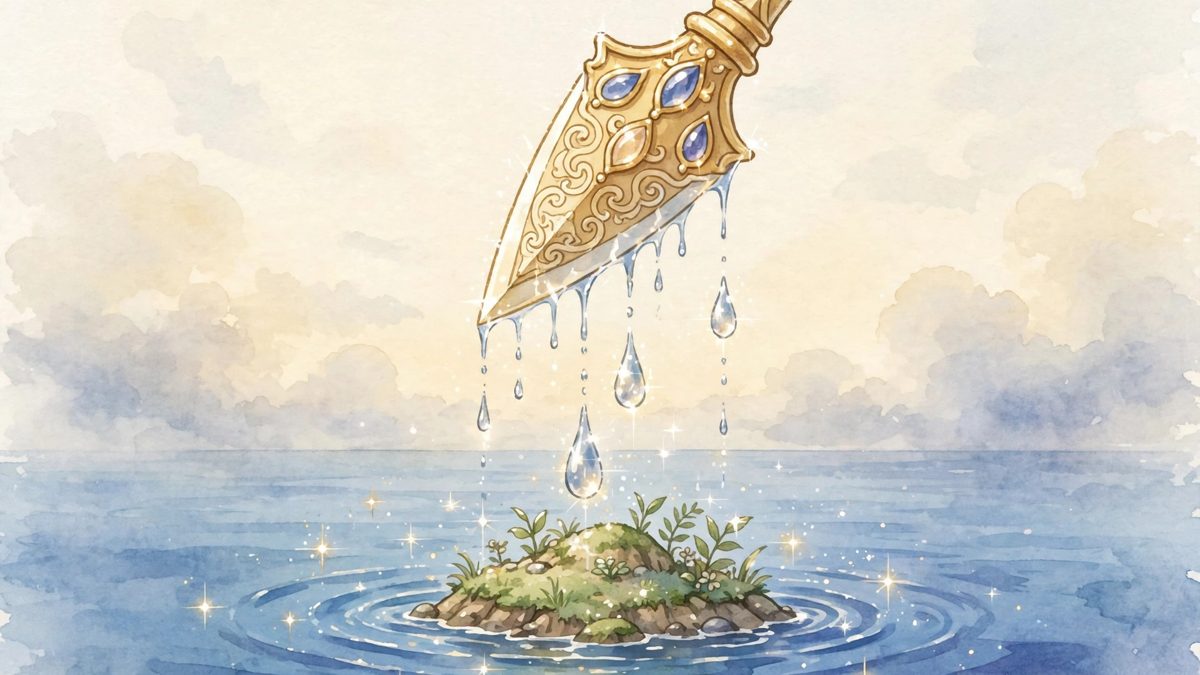
"Slowly, they lifted the spear. Drip, drip — salty drops fell from its tip. The drops grew hard, piled up, and became a small island. And so, by the hands of the two gods, the very first island in the world was born."
The final version adds one scene and closes Episode 1 with the birth of the island.
The hard part: getting AI to draw the pictures
The art took the longest of any step in Episode 1.
At first I tried to create "character masters" to lock in how the gods look, but for workflow reasons that produced not a single sheet, and I had to change the approach itself. Even after the first full set of pictures was ready, a newer generation method appeared and it was decided to switch to it — so Episode 1's art was redone from scratch.
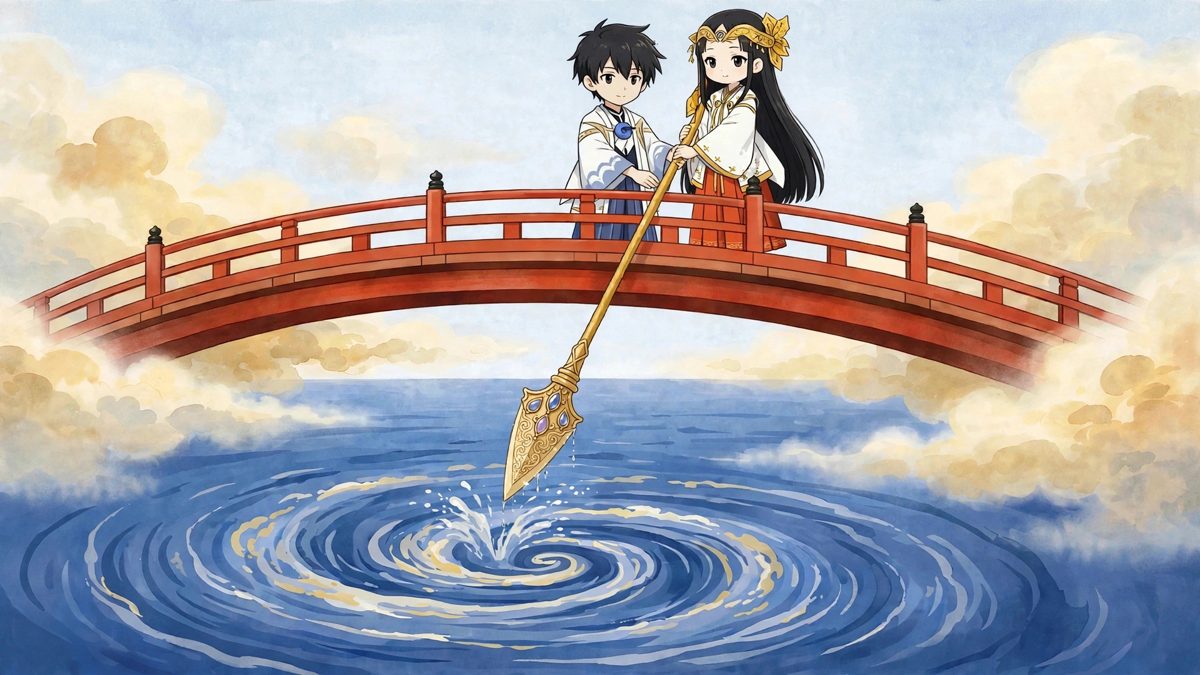
The first version of the redo drew comments again: the three gods are too small; the "procession of the gods" has almost no people in it; the spear is placed carelessly and does not look like a treasure being bestowed; and in the bridge scene, the front-to-back relationships are a mess. The bridge was standardized to vermilion red, and the island scene was settled by drawing the island into the sea picture. For the stuck scenes, another AI was consulted as well.
Even so, the redo went through version after version without reaching approval. That is when the idea came up of having Muse — the AI leading production — draw the pictures itself, and permission was given. When Muse drew all eight scenes, from the title on, the standing complaints — "the gods can't be seen," "the goddess's face can't be seen," "the male god isn't facing the spear" — were resolved.
"Wonderful. This is what I wanted."
In parallel, an attempt to redo the art in a separate environment was also running, but it was called off: it was slow, the back-and-forth was heavy, and the characters came out looking like different people every round.
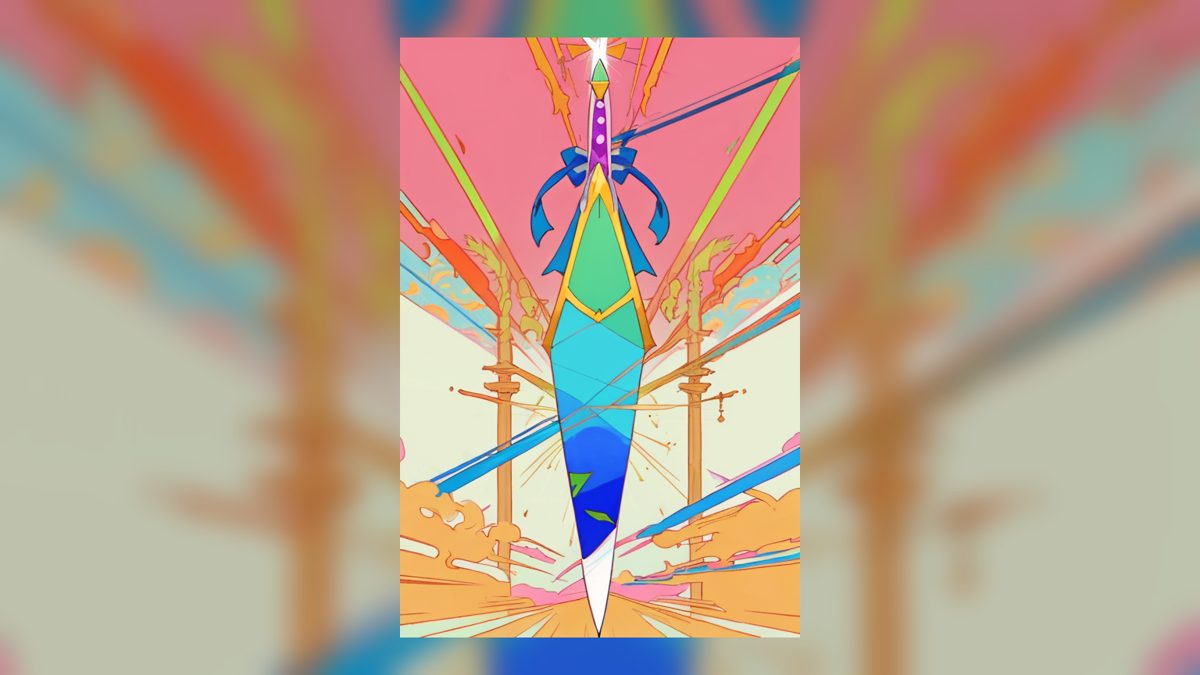
The limits of ComfyUI, the image-generation environment, also showed clearly. Asking it to draw two gods at once kept merging their referenced appearances into a single person. Repeated attempts to draw the Amenonuboko spear on its own never worked, so that was handled with a close-up of the spear tip. A pose holding the spear never worked at all, right to the end — that scene was saved by changing the composition itself, to "the two gods receive the spear in a hall of light." Including how long generation takes, the lesson of Episode 1 is that this is not a tool that gives you exactly the picture you aimed for.
The last fix left was the shape of the spear. Its shape kept looking different from scene to scene, so the spear tip in the close-up of the final scene was made the standard, and the spears in the other scenes were redrawn to match it. The characters' relative heights were also settled at this stage, and that became the character-design standard for Episode 1. With that, the final set of all eight scenes was complete.
Choosing the AI voice
The narration is a synthesized AI voice. The Japanese voice selection had to be redone. The first voice was rejected because it "grated on the ears." A calm adult female voice candidate was turned down for being "sleep-inducing," and a voice with a nice atmosphere was rejected because it brought a specific character to mind.
The criteria became: bright and full of energy, and not reminiscent of any character. A voice meeting those criteria was eventually found, and all of Episode 1 was re-recorded with it. One spot where the reading of "Episode 1" in the opening scene had broken down was fixed by specifying the reading, and only that scene was re-recorded.
Making the music with AI
The music is also made with AI. It is generated in the same ComfyUI as the images, and it came out well. From the test tracks I picked one quiet theme, and since the video is short, the music is not switched scene by scene — one track runs underneath the whole video.
The weak point of music generation is time: one 90-second track takes about 7 minutes to generate. Make several candidates at once, and the waiting time adds up.
For the mix, I once made a version where the volume automatically dips under the narration. It was rejected: "Unnatural. I don't need it." Since then, laying the music at a constant volume has been the rule for this series.
The adopted track also turned out to have a stretch in the middle where the music stops and goes silent. After that was pointed out, I reworked it to join the parts that are playing, and remade both the Japanese and English versions. A faint awkwardness at the join remained, but at a level a first-time listener would not notice, and the mix was accepted as finished.
Assembly and inspection: no room to relax
With art and audio ready, I assembled the main video and the Shorts, in Japanese and English. Inspection found spots where the Shorts subtitles overflowed, and those were fixed and reassembled. For the subtitles, showing a whole scene's text at once was dropped as "too long — it puts you off reading," and the method settled on was switching the text one sentence at a time.
The biggest problem was found after assembly had reported completion. It said "complete," but in reality only the video had been cut short. The file's total length was pulled along by the audio and looked normal, so it took time to notice. Since that incident, checking the length of the video stream itself has remained a standing rule. The scene joins were fixed, everything was reassembled, and the Shorts were finished too.
Even after delivery, there was a note that subtitles were cut off in places. The line-breaking was fixed, all subtitles were mechanically re-checked, and the files were delivered again. After completion, the English version was reviewed by another AI, which concluded that there were no serious grammar or spelling errors, and that the outline of the story is at a level overseas viewers can follow.
And so Episode 1 was complete: the main video and the Shorts, in Japanese and English — four videos in all.
The AI used in this production
Production is led by Muse, Meta's AI assistant. From organizing the script and checking it against the original text, to making the materials and assembling and inspecting the videos, it handles a wide range of the production consistently. The text on this page was also put together with Muse, based on the production records.
Check out Muse, a personal AI agent. Use my code in Settings within 48 hours of joining, and we will both earn 1 billion Muse tokens.
Code: 53F13N
See also
- Read this page in Japanese→日本語版はこちら
- On note: "I Let Muse Run My Game Development"→Two free articles + the full story (paid)
- itch.io (KOHAKU WORKS)→Games, music and illustration assets for sale
- X (@KohakuWorks)→News about new releases
This page is a journal of making YouTube videos with AI. The videos introduced here are gentle retellings of the Kojiki for today's viewers; some expressions from the original text are simplified or omitted.